Tri Kedar Yatra
8D/7N
Easy-Moderate
↬ Overview
The Tri Kedar Yatra is a spiritually immersive pilgrimage to three revered abodes of Lord Shiva — Madhyamaheshwar, Rudranath, and Kalpeshwar — nestled deep within the pristine Garhwal Himalayas of Uttarakhand. This yatra is ideal for devotees and seekers who wish to experience the essence of Panch Kedar while undertaking a more focused and accessible journey through Shiva’s sacred Himalayan manifestations.
Rooted in the timeless legend of the Mahabharata, the Tri Kedar temples are associated with the divine disintegration of Lord Shiva, who eluded the Pandavas by transforming into a bull. When Bhima attempted to stop him, Shiva disappeared into the earth, reappearing in different forms across the Himalayas. Madhyamaheshwar enshrines the navel (nabhi), Rudranath worships the face (mukha), and Kalpeshwar venerates the matted hair (jata)of Lord Shiva. Together, these three shrines form a powerful spiritual circuit representing surrender, penance, and liberation.
Unlike Kedarnath and Tungnath, which are more accessible, Tri Kedar temples retain a raw, ascetic, and meditative character. The journey takes pilgrims through remote villages, ancient foot trails, dense forests, alpine meadows (bugyals), and high-altitude ridgelines. The absence of commercial bustle allows devotees to connect deeply with nature and inner consciousness, making this yatra as much an inward journey as a physical one.
Spiritual Significance of the Three Kedars
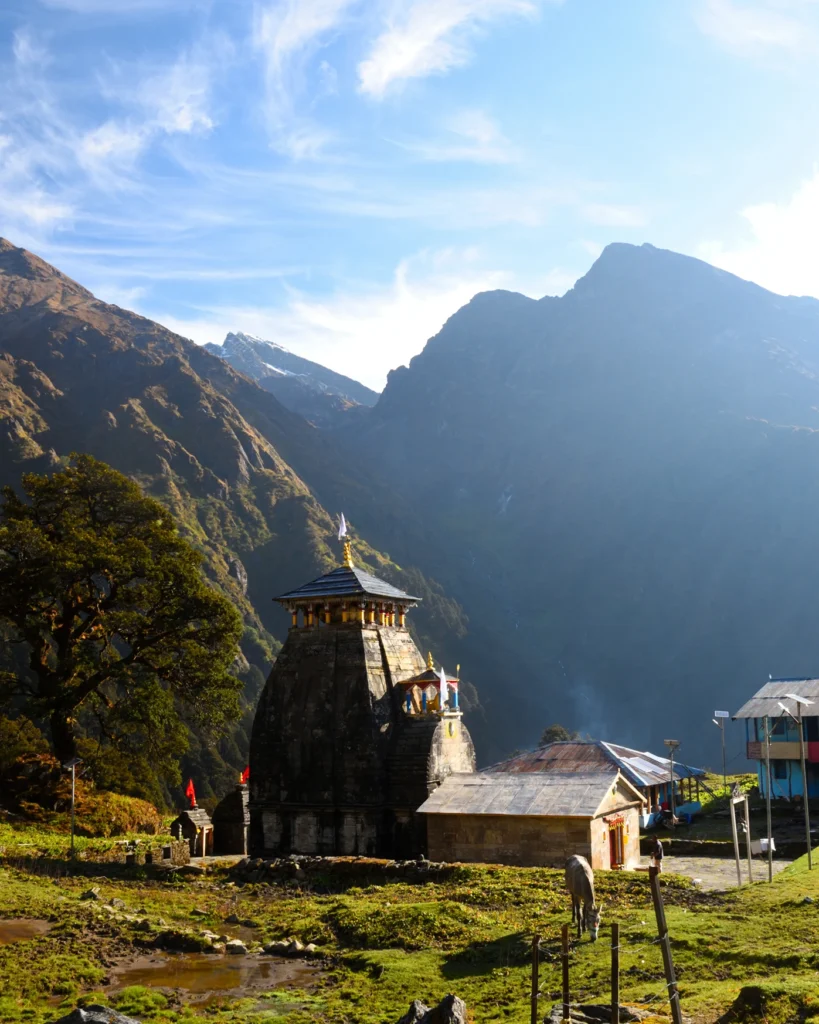
Madhyamaheshwar, located in a serene high-altitude valley, is associated with balance and inner stillness. The temple is surrounded by towering Himalayan peaks such as Chaukhambaand Neelkanth, creating a natural amphitheater of silence. The trek to Madhyamaheshwar via Ransi and Kun Chatti is gradual yet demanding, symbolizing the spiritual discipline required to reach Shiva’s subtle form.
Rudranath is considered the most mystical and challenging of all Kedar shrines. Here, Lord Shiva’s face appears in a natural rock formation, set against dramatic landscapes of alpine meadows and sacred kunds like Surya Kund and Chandra Kund. The remoteness of Rudranath enhances its spiritual potency, drawing seekers who value solitude, endurance, and contemplation.
Kalpeshwar, the final temple of the Tri Kedar Yatra, is unique as it remains open throughout the year. Located inside a natural cave, Kalpeshwar is associated with sages and ascetics who meditated here for centuries. The presence of the sacred Kalpavriksha tree adds to its mythological importance, making it a place of fulfillment and spiritual completion.
Journey Through Devbhoomi
The Tri Kedar Yatra begins from Haridwar, the gateway to Devbhoomi Uttarakhand, and gradually ascends into the heart of the Garhwal Himalayas. The route is thoughtfully designed to allow acclimatization, with trekking days balanced by driving and rest segments. Starting with a drive to Ransi, the traditional base for Madhyamaheshwar, the yatra progresses through Kun Chatti, high-altitude meadows, and remote forest paths before culminating at Kalpeshwar.
This pilgrimage is best undertaken between May to June and September to October, when weather conditions are stable and trekking routes are accessible. Monsoon months are not recommended due to landslides and slippery trails, especially on the Rudranath route.
Why Choose Tri Kedar Yatra
Best Time to Visit
May–June and September–October offer the most favorable weather and safe trekking conditions. Monsoon months are not recommended due to landslides and trail risks.
The Tri Kedar Yatra is not merely a pilgrimage; it is a sacred passage through faith, endurance, and the eternal presence of Lord Shiva in the Himalayas. Each step on this path brings the devotee closer to silence, surrender, and spiritual awakening.
Fitness & Medical Guidelines
Physical Fitness Requirements
- Ability to walk 8–12 km per day on mountainous terrain
- Comfortable with 5–7 hours of trekking on certain days
- Strong knees, ankles, and cardiovascular endurance recommended
Pre-Yatra Preparation (Highly Recommended)
- Begin brisk walking / jogging at least 4–6 weeks before the yatra
- Practice stair climbing with a light backpack
- Include breathing exercises or yoga for better stamina
Medical Guidelines
- Consult a doctor before the yatra if you have:
Heart conditions
Asthma or breathing disorders
High blood pressure
Diabetes or joint issue - Carry personal medicines in sufficient quantity
- Inform the trek leader about any medical condition in advance
Altitude Awareness
- Symptoms like headache, nausea, dizziness, or fatigue may occur
- Walk at a steady pace, stay hydrated, and avoid overexertion
- Immediate descent is advised if symptoms worsen

↬ Itinerary
Haridwar to Ransi – Entering the Inner Himalayas
The journey begins from Haridwar, the sacred gateway to Uttarakhand. A scenic mountain drive through river valleys, confluences, and forested ridges brings you to Ransi village, the traditional base for the Madhyamaheshwar trek. Ransi is a peaceful Himalayan settlement that reflects authentic Garhwali culture and spiritual simplicity.
Meals: Dinner
Stay: Guesthouse / Homestay (Basic)
Drive Duration: Approx. 8–9 hours
Ransi to Kun Chatti – Trek Through Forest Trails
The trek begins from Ransi toward Kun Chatti, following centuries-old pilgrim paths. The trail passes through dense oak and rhododendron forests, small streams, and stone-paved village routes. Kun Chatti serves as a natural acclimatization and rest point before the longer ascent ahead.
Trek Distance: ~7 km
Meals: Breakfast, Dinner
Stay: Basic Dormitory / Tents
Kun Chatti to Madhyamaheshwar Temple – Darshan & Rest
Today’s trek ascends through alpine meadows and open ridgelines to reach Madhyamaheshwar Temple (approx. 3,497 m). This sacred shrine marks the place where the navel (nabhi) of Lord Shiva is worshipped. After darshan, the rest of the day is reserved for rest, acclimatization, and spiritual immersion, allowing pilgrims to absorb the profound silence and energy of the high Himalayas.
Trek Distance: ~12 km
Meals: Breakfast, Dinner
Stay: Basic Dormitory near the temple
Early Morning Hike to Budha Madhyamaheshwar | Descend to Ransi | Drive to Sagar
An early morning hike leads to Budha Madhyamaheshwar, believed to represent the ancient or elder form of Lord Shiva and associated with great sages of the past. After darshan, pilgrims descend gradually back to Ransi village. From Ransi, the journey continues by road to Sagar village, the starting point for the Rudranath trek.
This day symbolically marks the transition from Madhyamaheshwar to the mystical realm of Rudranath.
Meals: Breakfast, Dinner
Stay: Guesthouse at Sagar
Sagar to Lyuti Bugyal – Trek Across Alpine Meadows
The trek from Sagar to Lyuti Bugyal takes pilgrims through dense forests that eventually open into vast alpine meadows, known locally as bugyals. Lyuti Bugyal offers stunning panoramic views of Himalayan ridgelines and serves as a crucial resting and acclimatization point before the ascent to Rudranath.
Trek Distance: ~10 km
Meals: Breakfast, Dinner
Stay: Tents (8–10 sharing)
Lyuti Bugyal to Rudranath Temple – The Most Mystical Kedar
This is the most challenging yet spiritually rewarding day of the Tri Kedar Yatra. The trail leads to Rudranath Temple, where the face of Lord Shiva is worshipped in a natural rock formation. Surrounded by sacred kunds like Surya Kund and Chandra Kund, Rudranath offers unmatched solitude and a deeply meditative atmosphere.
Trek Distance: ~6 km
Meals: Breakfast, Dinner
Stay: Tents near the temple
Rudranath to Sagar | Drive to Urgam Valley
After early morning darshan, pilgrims descend back to Sagar village. From here, a scenic drive leads to the Urgam Valley, near Kalpeshwar. The changing terrain from high alpine landscapes to fertile valleys provides a grounding close to the yatra.
Meals: Breakfast, Dinner
Stay: Guesthouse
Kalpeshwar Darshan | Drive to Rishikesh – Completion of the Yatra
The final day includes darshan at Kalpeshwar Temple, the only Kedar shrine open throughout the year. Located inside a natural cave, Kalpeshwar is where Lord Shiva’s jata(matted hair) is worshipped. After darshan, the journey concludes with a drive to Rishikesh, marking the spiritual completion of the Tri Kedar Yatra.
Meals: Breakfast
↬ Inclusion & Exclusion
- Transportation: Ground transportation from Haridwar to Rishikesh as per itinerary by suitable vehicle (Tempo Traveller / Bolero / similar).
- Accommodation: Guesthouses / homestays at lower altitudes, Basic dormitories near temples, Camping in alpine regions (Lyuti Bugyal & Rudranath) (Accommodation is simple due to remote Himalayan locations.)
- Meals: Daily simple vegetarian breakfast and dinner from Day 1 dinner to Day 8 breakfast.
- Guided Support: Experienced local trek leader / guide for all trekking days. On-ground coordination throughout the yatra.
- Permits & Fees: Forest permits, entry fees, tolls, parking, fuel, and driver allowances.
- Safety Support: Basic first-aid kit and emergency assistance during treks.
- Merchandise: Tri Kedar Yatra T-shirt (one per participant).
- Trek Support: Pony, mule, palki, porter, or personal load-carrying charges.
- Temple Rituals: Special pooja, abhishek, VIP darshan, offerings, or donations at temples.
- Personal Expenses: Bottled water, snacks, soft drinks, tips, laundry, phone calls, room heaters, or personal shopping.
- Insurance & Medical: Travel insurance, medical insurance, medicines, hospitalization, evacuation, or rescue costs.
- Trekking Gear: Jackets, shoes, rainwear, walking poles, sleeping bags, backpacks, or any personal equipment.
- Weather / Force Majeure: Additional costs due to landslides, road closures, weather delays, government restrictions, or natural calamities.
- Others: Any service not explicitly mentioned in the Inclusions section.
↬ Things to Carry
Mandatory
- Government ID proof (Aadhaar / PAN / Driving License)
Footwear
- Waterproof high-ankle trekking shoes
- Woollen/thermal socks (1 pair)
- Socks (4-6 Pairs)
- Slippers (for camps/travel)
Backpack
- 50-60L trekking backpack with rain cover
- Ziplock/dry bags
Clothing (Winter Essentials)
- 1 Thermal innerwear (top & bottom)
- 4 Full-sleeve dry-fit T-shirts
- 1 Fleece or woollen layer
- 1 Heavy padded/down jacket (mandatory)
- 3 Trek pants (quick-dry)
- Woollen cap, neck warmer
- Waterproof gloves + inner gloves
Trek Essentials
- Water bottles (2–3 litres) / thermos
- Energy snacks (dry fruits, bars, chocolates)
- Trekking poles (recommended)
- Head torch/flashlight
Accessories & Care
- Sunglasses, sunscreen, lip balm
- Power bank
- Basic toiletries & hand sanitizer
Personal Medicines
- Prescription medicines (if any)
- Paracetamol, ORS, antacid, motion-sickness tablets
- Band-aids
↬ FAQ's
Tri Kedar Yatra covers Madhyamaheshwar, Rudranath, and Kalpeshwar, three sacred abodes of Lord Shiva in Uttarakhand. It is a spiritually intense pilgrimage combining trekking and devotion.
The yatra is moderate to strenuous. Treks to Madhyamaheshwar and Rudranath involve long walking hours, steep ascents, and high-altitude terrain.
Previous trekking experience is helpful but not mandatory. However, good physical fitness and mental preparedness are essential.
The best months are May to June and September to October. Monsoon season (July–August) is not recommended due to landslides and slippery trails.
Kalpeshwar is mostly road-accessible, followed by a short walk. It is the only Kedar temple open throughout the year.
Accommodation is basic and functional, including guesthouses, dormitories, and tents. Luxury facilities should not be expected in remote regions.
This yatra is not recommended for elderly pilgrims unless they are physically fit and accustomed to long walks at altitude.
Forest and local permits are required and are included in the package.
Yes. The itinerary may change due to weather conditions, landslides, or government regulations, prioritizing participant safety.